Showing posts with label Women and Conflict. Show all posts

21 September 2015

Israel Ministry of Foreign Affairs: Israeli diplomat Nelly Shiloh, spoke at the UN’s meeting on The Role of Women in Countering Terrorism and Violent Extremism

Israeli diplomat Nelly Shiloh, spoke at the UN’s meeting on The Role of Women in Countering Terrorism and Violent Extremism:
“Around the world, women are often the first victims of violence – but they suffer in silence. They are kept on the periphery of the public sphere, and are unable to raise awareness on conflict-related issues concerning them directly.
By empowering women, here today and into the future, the international community will have agents everywhere supporting peace, tolerance and understanding.”
3:02/3:02
5,257 Views
Israel at the UN with Nelly Shiloh
“Around the world, women are often the first victims of violence – but they suffer in silence. They are kept on the periphery of the public sphere, and are unable to raise awareness on conflict-related issues concerning them directly.
By empowering women, here today and into the future, the international community will have agents everywhere supporting peace, tolerance and understanding.”
Israeli diplomat, Nelly Shiloh, spoke at the UN’s meeting on The Role of Women in Countering Terrorism and Violent Extremism:
"ברחבי העולם, נשים רבות הופכות לקורבנות המידיים של אלימות, אך הן סובלות בשקט. הן נדחקות לפינה, הרחק מעין הציבור, ולא מסוגלות לעורר מודעות סביב נושאים המשפיעים עליהן ישירות. על ידי העצמתן של נשים אלו, עכשיו ובעתיד, נוכל ליצור שחקניות חיזוק שיוכלו להביא לשלום, סובלנות וקבלה בכל מקום."
הדיפלומטית נלי שילה נאמה בדיון של האו"ם על תרומת הנשים במאבק בטרור ובאלימות:
“Around the world, women are often the first victims of violence – but they suffer in silence. They are kept on the periphery of the public sphere, and are unable to raise awareness on conflict-related issues concerning them directly.
By empowering women, here today and into the future, the international community will have agents everywhere supporting peace, tolerance and understanding.”
Israeli diplomat, Nelly Shiloh, spoke at the UN’s meeting on The Role of Women in Countering Terrorism and Violent Extremism:

" around the world, a lot of women become instant message to the victims of violence, but they suffer in silence. They are around the corner, out of the public, and never able to raise awareness around issues most influential them directly. By העצמתן of these women, now and in the future, we can create actresses reinforcement they can get peace, tolerance and acceptance everywhere."
Diplomatic Nelly Sheila spoke in a discussion of the United Nations for donating the women in the fight against terrorism and violence:

19 September 2015

Women's Views on News: Women and armed conflict: change needed

Source:   http://www.womensviewsonnews.org/2015/09/women-and-armed-conflict-change-needed/


Women and armed conflict: change needed

0 comments
women's rights, european union, ewl, child soldiers, sex slaves
Women’s multiple and diverse roles in conflict are hidden, poorly understood and, at times, dismissed.

Did you know that 40 per cent of all child soldiers are girls? They are often used as ‘wives’ – ie sex slaves – of the male combatants.
Did you know that in contemporary conflicts, as many as 90 per cent of the casualties are civilians, most of whom are women and children?
Or that of the 14 peace negotiations held under UN auspices in 2011, only four women participated in any of the negotiation teams?
And conflict, war and militarism are gendered processes.
They use, maintain and often promote the traditional ideological construction of “masculinity” and “femininity”: men go to war to defend or promote national/state values, territories and borders, and to protect their ‘own’ women and children.
Women are considered passive, and are the targets of intolerable acts of violence, as a strategy of war.
Women’s multiple and diverse roles in conflict are hidden, poorly understood and, at times, consciously – or unconsciously – dismissed.
And because of this, women are not regarded as equal actors in peace building and democratic development; they are not allowed equal participation in the enforcement of rights and justice and the creation of human security for all.
The absence of women and their perspectives in peace negotiations, post-conflict reconstruction, disarmament, humanitarian relief and peace building, means the absence of sustainable peace and any chance of obtaining human security.
But more importantly, the persistence of wars and conflicts prevent the achievement of gender equality and women’s rights.
According to the Women’s International League for Peace and Freedom (WILPF), in recent years there has been an increasing number of states spending profusely on military activities; they continue to foster a culture of militarisation by maintaining their military budgets with secrecy, minimum transparency and limited accountability.
In 2013 alone, the total of global military expenditure surpassed USD 1700billion.
The same year, containing and dealing with the consequences of violence cost the world USD9.8 trillion, which accounts for 11.3 per cent of global GDP.
The increasing use of new technologies in conflict, such as armed drones or other dangerous chemicals, poses a clear threat to women’s human rights and human security and dignity in general.
The domestic responsibilities of women and their burden of caring for children, the elderly and the injured, generally increase during conflict.
Women also frequently lack control over productive resources or economic assets, even when they themselves are generating them.
And post-conflict discussion rarely takes into account the role of women during conflicts and doesn’t include appropriate compensation for them.
When demobilising child soldiers, equal attention and benefits should be awarded to the girls as well as the boys.
When conflict ends and displaced populations return to their home communities, there can be competition for scarce resources, land and property; if women’s rights are not protected by law, they can be left without access to the resources needed for livelihood generation, and become more vulnerable to violence and sexual exploitation.
It is time to redefine sustainable peace as the presence of human security, justice and equality, rather than the absence of war.
The European Women’s Lobby (EWL) is calling for a culture of peace and of respect for women’s human rights:
For an improved gender balance at decision-making levels of the European External Action Service.
For the appointment of a gender focal point in all of the European Union’s delegations and all Common Security and Defence Policy missions.
For the adoption of a binding “Code of Conduct” on the standards of conduct of military and civilian peacekeeping and humanitarian national and European Union staff while on mission in areas of armed conflict. Such codes should include an unequivocal condemnation of all forms violence against women, including prostitution and trafficking for the purpose of sexual exploitation;
For women’s human rights to be placed at the core of donor policies for reconstruction and development; and invest in women’s organisations as a means of conflict prevention and post-conflict reconstruction;
For a guaranteed access to justice (including transitional) for all women, as well as access to reproductive and sexual health services and support programmes, including for women victims of sexual violence;
For the European Union and its member states to cease promoting the current culture of increasing militarisation and redirect their ‘military first’ budgets towards gender-aware budgets that consider the multiple needs of women and address gender equality as a priority; and
For the European Union and its member states to recognise sexual violence and gender-based violence as legitimate grounds for asylum and grant asylum to women who for these reasons have had to flee their country.
After conflict, female voters are four times as likely as men to be targeted for intimidation in elections in fragile and transitional states.
There also tends to be a significant increase in female-headed households during and after conflict – up to 40 per cent of households even – and these are often the most impoverished, all the more so as post-conflict actions don’t include financial compensation.
The European Parliament is one of the most active and engaged European institutions on the issue of women and armed conflict, and several MEPs do consistently drive the issue forward and put pressure the European Union and the European Commission to do more on the issue.
But any mainstreaming of gender equality within EU policy frameworks such as development and humanitarian aid, security and defence policy and missions, and human rights more generally, needs to be comprehensive.
To find out more about the European Women’s Lobby member organisations and partners which are dedicated to supporting and expanding women’s human rights in conflict click on these links: Global Justice Centre, Women in International Security (WIIS) and the Women’s International League for Peace and Freedom (WILPF).
And forward this post to your MEP so they know too.
- See more at: http://www.womensviewsonnews.org/2015/09/women-and-armed-conflict-change-needed/#sthash.ooJ6w9uK.btAqyUgP.dpuf

The Mosaic Institute: Mosaic Hosts “2014 Citizen Summit on Women & Armed Conflict” 15 November 2014)

Source: http://www.mosaicinstitute.ca/#!Mosaic-Hosts-%E2%80%9C2014-Citizen-Summit-on-Women-Armed-Conflict%E2%80%9D-/c1ls0/8507A68E-3E56-4490-BDA1-581CBE358D10


Mosaic Hosts “2014 Citizen Summit on Women & Armed Conflict”
November 27, 2014

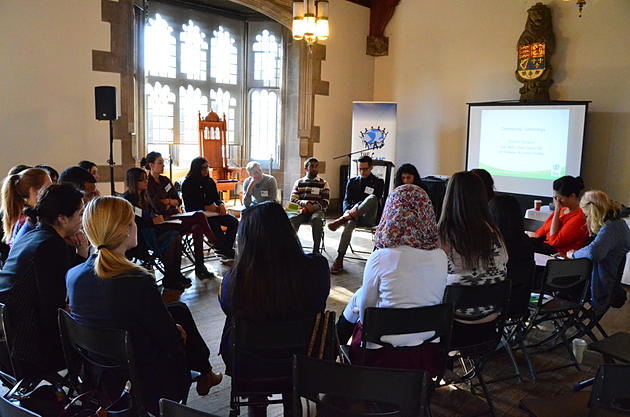
Citizen Summit Delegates Participate in Breakout Session

On Saturday November 15, the Mosaic Institute hosted its 2014 Citizen Summit on Women & Armed Conflict, a day-long student conference that explored issues relating to gender-based violence and women’s efforts to promote peace in Canada and around the world. The event featured a stellar line-up of distinguished speakers on such topics as sexual violence, conflicts and diaspora women, the roles of women in combat, and the effect of conflict on gender-based violence.  This year’s Citizen Summit differed from those in the past in that it did not focus on a single geographic location, but rather on an issue that affects people all over the world, including Canadians with connections to a multitude of regions overseas affected by conflict.  In that sense, the Citizen Summit provided a much-needed opportunity for inter-community learning and collaboration.

The Citizen Summit, held at the University of Toronto’s Hart House, brought together over 100 students and community members with a shared interest in women’s rights, peace building, and justice. 27,000 more people joined in the conversation via Twitter.

Conference highlights included keynote addresses by Ilana Landsberg-Lewis, Executive Director of the Stephen Lewis Foundation, and Dr. Kim Stanton, Legal Director of the Women’s Legal Education and Action Fund (LEAF). Both described their passionate involvement in work to empower women in conflict situations. Other notable speakers included Dr. James Maskalyk of MSF Canada, Dr. Jamie Rowen of the University of Toronto’s Centre for Criminology and Socio-Legal Studies, Commander Sandra Sukstorf of the Canadian Forces, and Dr. Amarnath Amarasingam of Wilfrid Laurier University. “The Citizen Summit was a great representation of what the Mosaic is all about, and touched on some of the major issues of today surrounding women and armed conflict,” said Citizen Summit attendee Emma Compeau, a Peace and Conflict Studies student at the University of Toronto.

This international examination of issues relating to women’s roles in armed conflict included a discussion of the issue of Canada’s missing and murdered Aboriginal women, a contemporary phenomenon that many indigenous Canadians point to as an ongoing after-effect of the violence often used against indigenous women at the time of European Settlement. The Mosaic Institute welcomed four Aboriginal Elders to facilitate community gatherings which engaged conference delegates in meaningful discussion on the topic.

The Citizen Summit on Women & Armed Conflict was presented as part of the Mosaic Institute’s UofMosaic program. UofMosaic is the Mosaic Institute’s innovative peace building and leadership development program for university students across Canada. The program delivers programming at Ryerson University, York University, the University of Toronto, Concordia University, McGill University, and Simon Fraser University. UofMosaic is made possible by the generous financial support of BMO Financial Group. For more information, please contact Program Manager Jothi Shanmugam at js@mosaicinstitute.ca
.

Hanna’s House Summer School 2010 (27-29 August)

Source: http://www.hannashouse.ie/index.php?option=com_content&task=view&id=49


Hanna’s House Summer School 2010


Programme for Hanna’s House Summer School 2010
In collaboration with the Transitional Justice Institute, University of Ulster


A Feminist Peace: How do we get there?
27-29 August 2010
University of Ulster Belfast Campus, York Street.
Hanna's House mission is to mobilise the collective energy of women to work towards feminist ideals of justice, equality and non-violence.
*The Hanna’s House Peace Project is funded by the Joseph Rowntree Charitable Trust.

‘The Wars on Women: Peace Works’ Art Exhibition is funded by the Arts Council of Northern Ireland.
Friday 27 August 2010:
6-8.30pm: official opening of the Summer School.
6pm: Hanna’s House Feminist Peace Building Project
Margaret Ward, chair of Hanna’s House, welcomes everybody to the Summer School.
 6.10pm:  Opening address                                                      
By Joanna McMinn, Board director of Hanna’s House.                                                                     
6.45pm: Poetry recital
Ann Zell.
7.00pm: Feminist Art Exhibition: The Wars on Women: Peace Works
Launch by Roisin McDonough, CEO Arts Council.
Champagne reception and music by Yolande Carter and Marion Jordan.

Saturday 28 August 2010:  
9.30 registration for a 10am start.
10-10.50

Keynote: Kate Fearon. Women, peace and conflict: stories from Afghanistan. (Auditorium)
10.50-11.10
Tea, coffee & pastries.  Poetry recital by Grainne Tobin.
11.10-12.45Workshop A:
Niamh Reilly and Catherine O’Rourke. On the Consultative Group to the Department of Foreign Affairs regarding the National Action Plan for UNSCR1325.
11.10-12.45Workshop B:
Rob Fairmichael. How violent men can change their ways: what will enable them to move beyond violence whether it is interpersonal or military violence?
11.10-12.45Workshop C:
Mary Lodato. Healing through autobiographical writing and imagery- Scriptotherapy.
11.10-12.45Workshop D:
Joanna McMinn, Jennifer McCann, Caral ni Chuilin and Jenny Meegan. Feminism and Prison Education: educating women.
12.45-13.45      Lunch break (sandwiches and fruit). Poetry recital by Eilish Martin  from 12.45-13.00; presentation by Rita Duffy from 13.00 to 13.30; Ruth McCarthy presents E-Zines at 13.30.
13.45-15.15Workshop A:

Bronagh Hinds, Margaret Ward, Laura McMahon, Liz law. Lessons Learnt on UN Security Council Resolution 1325 from a cross-learning visit to Liberia. FULL
Workshop B:
Roberta Bacic. Sewing stories into arpilleras and quilts. Part I of a two-part workshop. (*please see materials required below).
Workshop C:
Breda Gahan. Gender based violence and the feminization of HIV.
Workshop D:
Noirin Clancy. Women into Public Life, cross border initiative between three women’s organizations in Derry/Londonderry, Donegal, and Scotland. FULL
15.15-15.45                  Tea, coffee & biscuits. Poetry recital by Ann Zell.
Afternoon session: 15.45-17.00
15.45-17.00Workshop A:
Cathleen O’Neill, Gillian Gibson and Eleanor Jordan.‘Frontline Feminism’ and the work of women’s centres north and south. FULL
Workshop B:
Roberta Bacic. Sewing stories into arpilleras and quilts. Part II
Workshop C:
Linda Kelly, Emma Rogan and Adelita Monteiro.  What does feminism mean to young women today?
Workshop D:
Micheline Sheehy Skeffington. Hanna and Frank Sheehy Skeffington, and the social justice issues they championed. (Auditorium)
17.00-17.15
Tea, coffee break.  Poetry recital by Maria McManus

17.15
Keynote: Professor Monica McWilliams.  Women and the peace process in the North. (Auditorium)
18.00                   Film screening in the auditorium ‘pray the devil back to hell’ Liberian women’s experience of conflict.
Saturday evening:  8pm: A social event will take place at the Crescent Arts Centre, 2-4 University Road, Belfast. There will be performances by individual musicians, comediennes and singers, followed by a disco. Cost £5.
Sunday 29 August 2010: 
09.30                   Tea, coffee & pastries.
10.00-11.00
Keynote: Mary Cullen. Feminism, Citizenship and Peace in Ireland: today and yesterday.

11.30-12.30Workshop A:
Claire Hackett and Laura McMahon.  International and national perspectives of how truth recovery processes help and hinder women’s access to justice and reconciliation.FULL
Workshop B:
Annie Campbell and Niamh Wilson.  Women, violence and security issues, north and south.
Workshop C:
Goretti Horgan, Sharon Meenan, and Roisin Barton. Anti-war action and the Raytheon case.
Workshop D:
Rola Hamed-O’Neill.  The Palestinian-Israel women’s peace movement.
12.30
12.30-13.30Panel discussion

Tea, coffee, juices available.
Ailbhe Smyth, Susan McKay and Finola Meredith.  Using the media to further the feminist cause. (Auditorium)
13.30 Hanna’s House closing comments by Ann Hope.
13.40 Mary Dorcey recites poetry. 
13.50 Deirdre McAliskey sings ‘Bread and Roses’.
14.00 Summer school ends.
The fee for the weekend is €10/£10 (waged) €5/£5 (unwaged). To reserve a place at the Hanna’s House Summer School 2010 please email Shirley Graham at hannashouse@nwci.ielisting the workshops you would like to attend and send a cheque to Hanna’s House, c/o National Women’s Council Ireland, 9 Marlborough Court, Marlborough Street, Dublin 1.  For more information refer to our website: www.hannashouse.net.

*For the workshop on ‘Sewing Stories into Arpilleras and Quilts’ you will need the following materials: Needles, scissors, a small sewing kit, if available some small little objects or personally valuable memory scraps of materials to include a personal touch to the work to be done.

In collaboration with the Transitional Justice Institute, University of Ulster.