This blog is a part of my body of research that seeks to analyse civil society's and academia's understanding of national security models from an academic perspective with a focus on Canada, Israel and the UK.
Showing posts with label United States of America. Show all posts
Showing posts with label United States of America. Show all posts
The Senate report released earlier this week is mainly about the CIA personnel who authorized and used torture. But the report also includes references to CIA personnel who raised concerns about the torture policies. CIA personnel raised...
he Opinion Pages | OP-ED CONTRIBUTOR
Pardon Bush and Those Who Tortured
By ANTHONY D. ROMERO DEC. 8, 2014
BEFORE President George W. Bush left office, a group of conservatives
lobbied the White House to grant pardons to the officials who had planned
and authorized the United States torture program. My organization, the
American Civil Liberties Union, found the proposal repugnant. Along with
eight other human rights groups, we sent a letter to Mr. Bush arguing that
granting pardons would undermine the rule of law and prevent Americans
from learning what had been done in their names.
But with the impending release of the report from the Senate Select
Committee on Intelligence, I have come to think that President Obama
should issue pardons, after all — because it may be the only way to establish,
once and for all, that torture is illegal.
That officials at the highest levels of government authorized and
ordered torture is not in dispute. Mr. Bush issued a secret order authorizing
the C.I.A. to build secret prisons overseas. The C.I.A. requested authority to
torture prisoners in those “black sites.” The National Security Council
approved the request. And the Justice Department drafted memos providing
the brutal program with a veneer of legality.
My organization and others have spent 13 years arguing for
accountability for these crimes. We have called for the appointment of a
special prosecutor or the establishment of a truth and reconciliation
commission, or both. But those calls have gone unheeded. And now, many of
those responsible for torture can’t be prosecuted because the statute of
limitations has run out.
To his credit, Mr. Obama disavowed torture immediately after he took
office, and his Justice Department withdrew the memorandums that had
provided the foundation for the torture program. In a speech last year at the
National Defense University, Mr. Obama said that “we compromised our
basic values — by using torture to interrogate our enemies, and detaining
individuals in a way that ran counter to the rule of law.”
But neither he nor the Justice Department has shown any appetite for
holding anyone accountable. When the department did conduct an
investigation, it appeared not to have interviewed any of the prisoners who
were tortured. And it repeatedly abused the “state secrets” privilege to derail
cases brought by prisoners — including Americans who were tortured as
“enemy combatants.”
What is the difference between this — essentially granting tacit pardons
for torture — and formally pardoning those who authorized torture? In both
cases, those who tortured avoid accountability.
But with the tacit pardons, the president leaves open the very real
possibility that officials will resurrect the torture policies in the future.
Indeed, many former C.I.A. and other government officials continue to insist
that waterboarding and other forms of torture were lawful. Were our
military to capture a senior leader of the Islamic State who was believed to
have valuable information, some members of Congress would no doubt
demand that our interrogators use precisely the barbaric and illegal methods
that the Obama administration has disavowed.
The Obama administration could still take measures to hold
accountable the officials who authorized torture. Some of the statutes of
limitations have run out, but not all of them have. And the release of the
Senate’s report provides a blueprint for criminal investigations, even if that’s
not what the intelligence committee set out to do.
But let’s face it: Mr. Obama is not inclined to pursue prosecutions — no
matter how great the outrage, at home or abroad, over the disclosures —
because of the political fallout. He should therefore take ownership of this
decision.
authorized conduct that violated fundamental laws, and compromised our
standing in the world as well as our security. If the choice is between a tacit
pardon and a formal one, a formal one is better. An explicit pardon would
lay down a marker, signaling to those considering torture in the future that
they could be prosecuted.
Mr. Obama could pardon George J. Tenet for authorizing torture at the
C.I.A.’s black sites overseas, Donald H. Rumsfeld for authorizing the use of
torture at the Guantánamo Bay prison, David S. Addington, John C. Yoo and
Jay S. Bybee for crafting the legal cover for torture, and George W. Bush and
Dick Cheney for overseeing it all.
While the idea of a pre-emptive pardon may seem novel, there is
precedent. Presidents Abraham Lincoln and Andrew Johnson pardoned
Confederate soldiers as a step toward unity and reconstruction after the Civil
War. Gerald R. Ford pardoned Richard M. Nixon for the crimes of
Watergate. Jimmy Carter pardoned Vietnam War draft resisters.
The spectacle of the president’s granting pardons to torturers still makes
my stomach turn. But doing so may be the only way to ensure that the
American government never tortures again. Pardons would make clear that
crimes were committed; that the individuals who authorized and committed
torture were indeed criminals; and that future architects and perpetrators of
torture should beware. Prosecutions would be preferable, but pardons may
be the only viable and lasting way to close the Pandora’s box of torture once
and for all.
Anthony D. Romero is executive director of the American Civil Liberties Union.
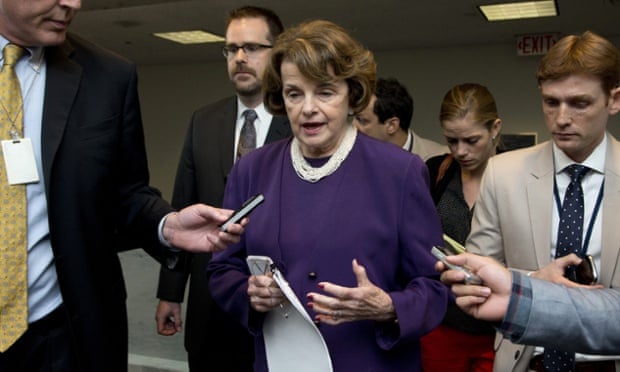
Secretary of state John Kerry asked Dianne Feinstein on Friday to consider the timing of the expected release of a report on CIA interrogation techniques. Photograph: Manuel Balce Ceneta/AP
The CIA is bracing for what could be one of the most damaging moments in its history: a public airing of its post-9/11 embrace of torture.
The Senate intelligence committee is poised to release a landmark inquiry into torture as early as Tuesday, after the Obama administration made a last-ditch effort to suppress a report that has plunged relations between the CIA and its Senate overseer to a historic low point.
White House spokesman Josh Earnest said on Monday the administration welcomed the release of the report, but warned US interests overseas were at risk of potentially violent reactions to its contents.
The release of the torture report will represent the third major airing of faulty CIA intelligence in 15 years, following official commissions into the 9/11 plot and Saddam Hussein’s defunct illicit weapons programs.
Despite months of negotiation over how much of the 6,000-page report will be declassified, most of its findings will never see the light of the day. But even a partial release of the report will yield a furious response from the CIA and its allies.
On Sunday, George W Bush made a show of support for CIA operatives who had participated in torture, calling them “patriots”.
“We’re fortunate to have men and women who work hard at the CIA serving on our behalf,” he told CNN. “These are patriots and whatever the report says, if it diminishes their contributions to our country, it is way off base.”
The Senate report is likely to attract global attention, owing to the CIA’s network of unacknowledged prisons in places like Poland, Thailand and Afghanistan.
Bloomberg first reported that the committee understood Kerry to be arguing for suppressing the report, though the State Department denies it.On Friday, Secretary of State John Kerry called Senator Dianne Feinstein – the California Democrat who spearheaded the inquiry – to urge consideration of what spokeswoman Jen Psaki called the “foreign policy implications” of the report’s timing, suggesting it could inflame anti-American outrage worldwide.
Congressman Mike Rogers, the Republican chairman of the House Intelligence Committee said on Sunday that US allies have warned that the release of the report could provoke “violence and deaths”.
“I think this is a terrible idea,” Rogers told CNN. “Foreign leaders have approached the government and said, ‘You do this, this will cause violence and deaths.’ Our own intelligence community has assessed that this will cause violence and deaths”.
Several foreign governments, including the UK and Poland, are fearful of identification by the Senate and have added to the pressure on the committee.
Some of the CIA’s major allies included dictators whom Barack Obama relinquished US support for or even went to war to depose, such as Egypt’s Hosni Mubarak, Libya’s Muammar Gaddafi, and Syria’s Bashar al-Assad.
Jose Rodriguez, a former senior CIA official who has ardently defended torture, has already published an op-ed accusing Feinstein and her committee allies ofbreaking faith with a CIA it once wanted to do its utmost to stop terrorism. Several former CIA directors and Bush officials intend to argue that the Senate investigation is itself misleading.
Rodriguez, writing in the Washington Post, said that the committee’s conclusion that torture “brought no intelligence value is an egregious falsehood” and termed the report “a dishonest attempt to rewrite history”.
The report’s fundamental conclusions have been well-trailed. Senate investigators determined that the CIA’s embrace of mock-drowning, sleep deprivation, “stress positions”, sensory and dietary manipulation and other torture techniques were ineffective, and the CIA covered up that ineffectiveness by misrepresenting its results to Bush officials, Congress and the public.
Its executive summary examines 20 such instances during the 2002-2006 height of what the CIA prefers to call “enhanced interrogation techniques”.
Feinstein hoped the committee would finish its declassification negotiations with the administration within 30 days. Yet the White House placed the CIA in charge of censoring a report into its own conduct and discussions have stretched into their 10th month. In August, Feinstein and other leading Senate Democratsrejected proposed administration redactions, saying they would leave the committee’s findings incomprehensible. The agency has rejected even the use of pseudonyms for its operatives on the grounds they could reveal classified identities.
In an interview with the Los Angeles Times, Feinstein conceded that she had been obliged to give in on some of her demands for transparency: “We have to get this report out.”
“We will find another way to make known some of the problems,” she said.
The drawn-out process has prompted speculation that the administration wants to outlast Feinstein’s tenure as chairwoman and prefers for committee Republicans, who consider the inquiry a wasteful witch hunt, to preside over its partial release come January. Two committee Democrats, Ron Wyden of Oregonand Mark Udall of Colorado, have publicly flirted with using parliamentary procedure to force disclosure, considered to be an attempt at exerting pressure on the administration.
Human rights campaigners have pressured the White House for months to release a maximally declassified report so as to hold the CIA accountable. It is unlikely to lead to any legal consequence for CIA officials, particularly after a special Justice Department inquiry into torture declined to indict anyone for abuses in the CIA program. The report’s greatest legal impact may be on the military tribunal for the accused 9/11 co-conspirators, whose lawyers wish to introduce the report into evidence that their clients were tortured into delivering inadmissible statements implicating themselves.
Hostility to the report is not restricted to the right wing. Human rights groups have criticized Senate investigators for not looking into the Bush administration architects of the program in a concession to committee Republicans, and for declining to attempt a definitive legal analysis of torture. While the CIA has criticized the inquiry for not interviewing its operatives, lawyers for CIA torture victims have said Senate investigators did not seek to interview their clients, either.
Beyond questions of accountability, a lingering effect of the report is likely to be damage between the CIA and the secret Senate committee that oversees the powerful intelligence agency.
Director John Brennan had to apologize in July after the CIA inspector general determined that agency officials surreptitiously accessed committee work product and email on a firewalled shared network. Brennan had initially denied wrongdoing that Feinstein stated had provoked a constitutional crisis. Udall and others have called on Brennan – himself a senior CIA official during the time of the inquiry’s focus – to resign.