| |||||
|
Showing posts with label UK and asylum seekers. Show all posts
Showing posts with label UK and asylum seekers. Show all posts
04 September 2015
Muslim Women's Network UK: MWNUK Urges British Values in Response to Refugee Crisis
Source: via mass emailing


24 March 2014
Al Jazeera: Somalis fear 'death-sentence' deportations
Source: http://www.aljazeera.com/indepth/features/2014/03/somalis-fear-death-sentence-deportations-2014320105055706973.html
Somalis fear 'death-sentence' deportations | ||||
The UK has quietly been returning asylum seekers to Mogadishu, despite the threat of al-Shabab.
Simon Hooper Last updated: 22 Mar 2014 10:17
 | ||||
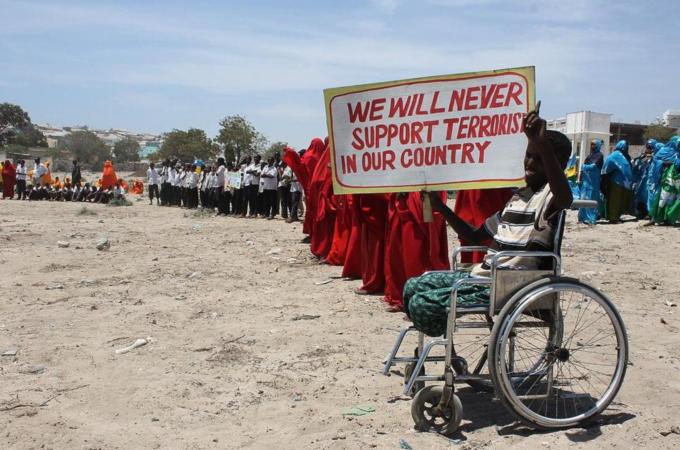
A disabled Somali boy holds a poster stating he will never support terrorism at an anti al-Shabab rally [AFP]
| ||||
| London, United Kingdom - When Ismail finally touched down on British soil early last year, after being smuggled over land and through the air from Somalia, he believed he was finally on the verge of beginning a new life. "The Britain I had in mind was one in which they welcomed people of different colour, different religion and different backgrounds and where human rights were respected," Ismail, who preferred not to use his real name, told Al Jazeera. "I wanted to live in a safe place where I could just study and work and help my family and support myself, so what happened to me was a big shock." Less than a year after failing in his bid to claim asylum in the UK, Ismail found himself handcuffed, forcibly placed aboard an airplane bound for the Somali capital, Mogadishu - a journey Ismail holds would have effectively been a death sentence. Ismail is one of a handful of known cases of Somali refugees recently detained and told they are to be returned to their conflict-stricken country, despite the severe security concerns and legal obstacles that have made it virtually impossible until now for British immigration officials to send them home. Members of Somali communities in the UK, as well as campaign groups and solicitors working on behalf of asylum seekers, say they fear these cases point to a tougher approach and a new returns programme at the Home Office, the UK's interior ministry - one that could endanger the lives of many others whose asylum claims are rejected. "When I told people in the Somali community what the Home Office was doing to me they said, 'No, that's impossible, it's unheard of. Nobody is stupid enough to remove people to Mogadishu,'" said Ismail. 'Be quiet' Yet at the end of January, after three weeks in a detention centre near a London airport, Ismail was bundled into a van, pushed aboard a Turkish Airlines flight to Istanbul and seated at the back of the plane between three guards tasked with removing him from the UK.
On arriving in Istanbul, Ismail's escorts asked Turkish immigration officials to place him in a cell. During the flight, he said, they had discussed going sightseeing and "chilling out" in the city while they waited for a connecting flight to Mogadishu. Then one of them received a phone call. Ismail's solicitor had secured a judicial review of his case. Instead of going to Mogadishu, he was flown back to London and returned to another detention centre. "I was already resigned to the death sentence that awaited me," he said. "I was helpless. I was mentally tortured." The UK has long had a policy of returning Somalis whose asylum claims are rejected to less volatile regions of the country that are safely accessible by air, such as Somaliland. But most of the country, including Mogadishu, has long been considered too dangerous as a return destination because of the ongoing conflict between government forces and al-Shabab rebels. But Paul Morris, a volunteer at the Somali Adult Social Care Agency in Manchester, said the UK government appeared to have been emboldened by a European Court of Human Rights judgment in a Swedish case last September, which ruled in favour of allowing repatriations to Mogadishu in circumstances where a returnee was not deemed to be at specific risk. In making that ruling, the court cited a report by Norwegian and Danish immigration authorities that said there had been a general improvement in the security situation. "It's based on a fact-finding mission by a few Nordic bureaucrats who went for about a week and produced a report. It's fatuous," Morris told Al Jazeera. "The judgment came out at the beginning of September. Two weeks later the Westgate attack happened in Nairobi, and al-Shabab proved its power." Increasing attacks Concerns over security in Mogadishu have continued to mount since then. Al-Shabab has shown itself still capable of mounting major attacks in the capital, such as last month's deadly assault on the heavily fortified presidential palace. A report this month by UN Secretary-General Ban-Ki Moon said the security situation remained volatile, with al-Shabab continuing to use "guerrilla and terrorist tactics" and deadly violence occurring almost daily.
But Morris said the Home Office, in opposing a bail application by a Somali man held in a Scottish detention centre since February, had revealed details of what he believes is a new programme to send Somalis home. "The Home Office can normally only justify detention if there is imminent removal planned," he said. "In the bail summary, they talked about a new pilot project to remove Somalis to Mogadishu. The removal directions were on Turkish Airlines via Istanbul." James McGuinness, an immigration advocate at law firm Jackson & Canter, also highlighted an immigration tribunal decisionin December last year, in which a Somali man's appeal against deportation was rejected on the grounds that the tribunal found nothing to suggest he would face a real risk of suffering serious harm. The tribunal noted that al-Shabab was "no longer the force they once were". "Obviously it's deeply controversial and highly problematic - and the rules counter everything we know about the current situation in Mogadishu," McGuinness told Al Jazeera. "There is a high risk there of indiscriminate violence." Others held Al Jazeera has identified at least three other Somali individuals currently in detention in the UK who, like Ismail, have been told that they are to be returned to Somalia. One of them told Al Jazeera he was a member of a tribal minority who had fled the country in 2012 after seeing all of his immediate family killed. An aunt, his only surviving relative, paid for him to be smuggled by plane to the UK, where his claim for asylum was rejected. Last month he was sent to a detention centre in the England's east and told he would soon be sent home. Like Ismail, he did not want to be identified out of fear that he could be targeted if he was forced back to Mogadishu. "It's very, very tough. There's a lot of people here who have lost their minds. They just lock you up all day, and everyone has something in their heart," he said. "But the biggest fear I have is not to be here, but to be sent back there because I am sure I will never leave. Definitely I think I will die."
"People are really alarmed. They think that to actually be forcibly sent back you haven't got a chance," he said. "No Somali is going to think that the British government is so brutal as to send people back, so the people [in Somalia] will assume them to be agents - and the punishment for being a spy or an agent is decapitation." The Home Office told Al Jazeera it could not confirm whether anyone had been returned to Mogadishu and did not reveal details of return routes for security reasons. "Returns to Somalia and Somaliland have taken place over the past year and we will seek to carry out further removals in the future," said a spokesperson. "However, we regularly review the way in which we do this and are working to develop more effective return routes." The spokesperson said the Home Office could not comment on Ismail's allegations that he was physically abused by his escorts without more details of his case. But his claims appear consistent with a recent UK government report raising concerns that some detainees being removed from the country had been subjected to "disproportionate use of force and restraint and examples of unprofessional behaviour". On his return to the UK, Ismail was held in a detention centre for 30 days. Finally, his solicitor secured his release on bail, on condition that he registered at a Home Office reporting centre every week. He was also electronically tagged. He said he was having nightmares and suffering mental trauma, and had become reclusive and fearful of other people as a consequence of his treatment. "They said to me, 'This isn't finished yet. We are still trying to remove you.' When I go to the reporting centre, I am always sweating and my heart jumps as I enter the building. I don't know what will happen to me. They can detain you any time they want to." Follow Simon Hooper on Twitter: @simonbhooper |

Subscribe to:
Posts (Atom)