This blog is a part of my body of research that seeks to analyse civil society's and academia's understanding of national security models from an academic perspective with a focus on Canada, Israel and the UK.
Showing posts with label UK Security Model. Show all posts
Showing posts with label UK Security Model. Show all posts
Gloria Steinem once said, Feminism is a reflection of the society from which it emerges.
I do believe that MI5 was understaffed to meet the challenges of post 9/11 threats to the security of the UK in the UK.
I do believe the ethnic, cultural and operational swing from the IRA to threats that were of various ethnic Muslim communities proved challenging to the service.
And I do believe it produced some less than favorable dynamics.
I am on the receiving end of one of their less than favorable dynamics.
I also believe the current Prime Minister's conceptualization and response to threats against the UK is a continuation of dynamics. Some of which I agree. Some of which I disagree.
It is a reason why there is a relatively new head of MI5.
And is the reason why some feminist organisations in London, England veered so heavily into the analysis of the UK's security model because the very vocal perception was that it was not working.
It is also the reason why I and some other London operating feminists for a time were being approached by men and women with an intense interest in the UK's security as it intersects with Israel's security.
Source: http://www.bbc.com/news/uk-33543352
Former agent: I was abandoned by MI5 after breakdown
A former MI5 spy has broken cover to give the BBC an unprecedented account of his life in service - and describe his anger at the way he was treated.
The agent, codenamed Robert Acott, said he spied for 18 years, mostly following Islamic and Irish terrorist suspects.
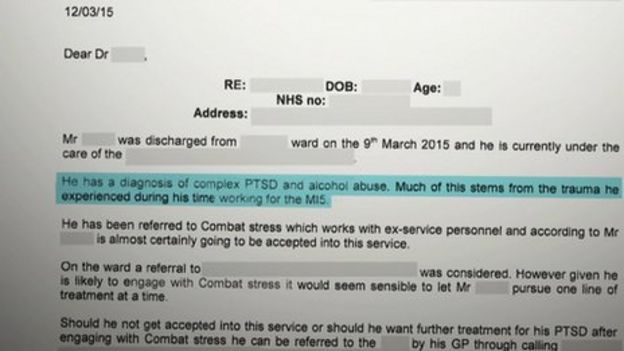
He told Newsnight MI5 pushed him out after he suffered symptoms of stress, later diagnosed as PTSD.
MI5 would not comment on the claims - but security sources said they felt his was only one side of the story.
In an interview with Newsnight, Acott says:
MI5 was completely unprepared for the Islamist terror threat and was so short-staffed during one major plot that it had to rely on British Transport Police to follow terrorist suspects
The agency had so few non-white officers that one team leader considered 'blacking-up' agents - this was tried on a training exercise
The agency had to undertake some surveillance operations because of suspicions of corruption and leaks within the police
He challenged senior managers when his team was tasked with looking at a suspected paedophile. Acott considered this beyond the agency's remit. The operation lasted several weeks, but he says he saw no evidence of child abuse
Acott, 46, was dismissed five years ago for misconduct after leaving an unmarked MI5 training manual in his garden shed. It was found by a member of the public and handed to police.
At the time he was sacked, Acott was suffering from panic attacks - and he has since been diagnosed as suffering from Complex Post Traumatic Stress Disorder, brought on by the pressure of his career in the service.
Acott claims MI5 took an opportunity to get rid of him. "MI5 was my life," he says. "I would have done - within reason - anything for them."
Though former director-generals of MI5 such as Dame Stella Rimington and Baroness Eliza Manningham-Buller have written about their time in the secret service, Acott's is the first account of life as a 'foot-soldier' in the dangerous and secretive world of counter-espionage.
Acott told Newsnight he was immensely proud to have been an MI5 surveillance officer - he was recruited from the Royal Navy by a senior officer.
He says he put himself in numerous dangerous situations because he believed in the work he was doing.
Media captionThe agent said MI5 was "totally understaffed" to meet the challenge after 9/11
But he admitted the pressure began to get to him after 9/11 when MI5 found itself completely unprepared for the Islamic terrorist threat. There was only one Muslim surveillance officer he was aware of in the whole of the surveillance unit.
"(MI5) was totally understaffed. We weren't used to dealing with the way they acted. The good thing about following Irish targets is the Active Service Units would generally meet in pubs you could go into.
"The Islamists would meet round each other's houses or in mosques which you can't get away with going into. Also, they were living in mostly ethnic areas and often you would find the only white people on the street were surveillance officers."
MI5 was blindsided by the July 7 attacks in 2005 and was stretched to breaking point when it helped foil the plot to detonate explosives on transatlantic airliners a year later.
"It was horrendous. We had around eight targets mostly based in Walthamstow, a couple in High Wycombe. It was 24 hours a day. It went on for quite some time," says Acott.
"With all of Special Branch, with all of MI5, there was just not enough people. CID became involved, British Transport police became involved. That's how desperate we'd become.
"If that airline job had gone as planned it would have eclipsed 9/11. It would have been horrendous."
Acott was in a team following the ringleader of the group, whose codename was Lion Roar. "He was the leader, he was the boss. He was in two minds about whether to martyr his wife and child as well as himself. Just before he was arrested, he took his wife and child with him to Mothercare. It seemed unbelievable to me that he could do that at the same time as he was thinking of killing so many people."
"They were making martyrdom videos. We had cameras hidden in the flat so we could see them videoing themselves."
Acott said following new suspects on the London underground became particularly stressful.
"The jobs I was really unhappy with was what they would call 'the first look up'. If they were a terrorist you had no idea at what stage they were at. I became particularly nervous of travelling on tubes with them."
"On one occasion this chap had shaved his head, which is a ritual they they go through. He was on the tube and was stood by the doors in the middle. I was at the end of the tube keeping an eye on him. I had been separated from my team.
"My body comms didn't work very well underground. I was on my own. I looked around. People were on phones, doing crosswords, a woman with a toddler trying to keep it under control. I started having a panic attack."
Media captionThe spy describes his first panic attack in the job
Acott says he travelled all over the world for MI5, following suspects out of the UK to Europe and the Middle East on a passport with a false identity.
He also went to Ireland to provide covert help to MI5 handlers who had meetings with IRA double agents.
Acott said the trips were undeclared to the Irish government and the surveillance teams would have been stranded had they been caught by republicans - or the Garda.
The surveillance on the suspected paedophile - codenamed Operation Saturday - caused him concern, he says, because he couldn't understand why MI5 was doing it.
"It involved extremely powerful, wealthy people. It was a very need to know job... We were given the scantest of briefings on it. All of a sudden the job stopped. I did actually question why were we doing paedophiles - it wasn't in our remit.
"The trouble with the police is they move from job to job. Special Branch only do it for three or four years. Then they go onto CID or some other job. There was a strong suspicion of corruption within the police, whereas MI5 was more highly trusted."
The operation ended after a few weeks - Acott says the target was using drugs and prostitutes, but he saw no signs of child abuse.
Acott says his health began to deteriorate in 2006. He began to have nightmares and panic attacks and he was drinking to help cope with the pressure.
"I know I was in a mess at the time. But the service didn't want to deal with that. Once they realised I had health problems, I think they just wanted rid of me.
Robert Acott has been diagnosed as having PTSD
"They went through the motions. I was definitely being bullied by my team leader and my junior team leader... They sent me to see a doctor. However the doctor wasn't there to help me as far as I could see. He was there to diagnose me as an alcoholic."
Acott was dismissed for gross misconduct over the file he had left in his garden shed. He told an MI5 tribunal the document was so dull he didn't believe it had any security status, but he was sacked.
The dismissal, he says, accelerated his health problems - he tried to commit suicide on at least three occasions. His parents, who have also spoken to the BBC, said they were convinced their son was suffering from PTSD, but a psychologist used by the service disagreed.
In a letter to his parents, MI5 said: "It is important to reiterate that this Department is not responsible for his health problems, nor do his problems stem from his time working here."
However, four doctors have now diagnosed him as suffering from PTSD - including clinicians from the military veterans' charity, Combat Stress.
Acott recently attended one of the charity's residential courses.
He told Newsnight he wants MI5 to admit it made a mistake when he was sacked. He also believes he is entitled to a medical pension.
Security sources insisted that MI5 has professional teams that support the physical and mental wellbeing of staff because of "the very particular nature of the work".
Sources said staff do come forward and that support teams are proactive "during difficult periods such as at a time of particular operational intensity or following the death of a colleague".
The full report with former MI5 agent Robert Acott was on Newsnight, on BBC Two at 10:30pm on Wednesday 15 July. You can also watch on iPlayer.
Britain is a nation united in shock and in grief. As the names and identities of the victims in Tunisia emerge – and the horror of what they faced becomes clear – those feelings grow. Everyone is asking the same thing: how can a day at the beach for families and friends have turned into a scene of such horror?
The man who did this, the smiling gunman with a Kalashnikov hidden in a parasol, demonstrates the level of evil we are dealing with. It's an evil we've seen on Mount Sinjar in Iraq and in shopping malls in Kenya; at magazine offices in Paris and in schools in Pakistan.
On the same day as the holidaymakers in Tunisia came under attack, workers near Lyon and worshippers in Kuwait fell victim to this evil, as did over 100 Syrians, who were executed in their homes in Kobane by ISIL.
But we will not be cowed. To our shock and grief we must add another word: resolve. Unshakeable resolve. We will stand up for our way of life. So ours must be a full-spectrum response – a response at home and abroad; in the immediate aftermath and far into the future.
The first thing we must do is everything we can to help the victims of this attack. Our consular crisis centre has been running 24/7. We now have a team of over 50 consular staff, police officers and experts from the Red Cross on the ground in Sousse.
Hundreds of police officers are now working on this operation both in Tunisia and here at home – providing vital support to families; helping the Tunisians to identify those that were murdered; and launching an investigation into what happened.
We are doing everything necessary to get people home and to help the injured, including sending a team of military medical liaison officers out to Sousse to assist with medevac as required.
And in the coming days we will do all we can to bring home those who lost their lives as quickly as possible. I have been speaking to President Essebsi to thank the Tunisian authorities for their assistance, and we've been discussing what more we can do.
Across the world, we must do more to work together and build our capacity to deal with terrorism. ISIL may use ancient barbarism in its methods of killing, but it is modern in its propaganda techniques, using social media as its primary weapon.
That is why we must give our police and security services the tools they need to root out this poison. And we must look at how we can work with countries like Tunisia to counter this online propaganda.
We must also deal with it at its source, in places like Syria, Iraq and Libya, from where ISIL is peddling and plotting its death cult. That means supporting governments to strengthen weak political institutions and tackle political instability.
These ungoverned spaces are the areas in which the terrorist groups thrive. British aircraft are already delivering the second largest number of airstrikes over Iraq, where ISIL has taken hold.
Our airborne intelligence and surveillance assets are assisting other countries with their operations over Syria. And we are working with the UN, our EU and US partners to support the formation of a Government of National Accord in Libya. And we will continue to work with our partners in the region.
The third thing, perhaps the most important thing, is confronting the poisonous ideology that is driving terrible actions like those we saw on Friday.
That ideology stems from an extremist narrative, which hijacks the religion of Islam. It says that the West is bad and freedom is wrong. It says that women are inferior and homosexuality is evil. It tells people that religious rule trumps the rule of law, that Caliphate trumps nation state.
To defeat this poisonous ideology, we must be clear about why it is so wrong. We must expose and defeat what it is that persuades young people, from Tunisia to Kuwait, from Belgium to Britain, to join ISIL.
When the gunman attacked innocent people spending time with their families on the beach, he was attacking the very things we stand for.
We must be stronger at standing up for our values – of peace, democracy, tolerance, freedom. We must be more intolerant of intolerance – rejecting anyone whose views condone the Islamist extremist narrative and create the conditions for it to flourish. We must strengthen our institutions that put our values into practice: our democracy, our rule of law, the rights of minorities, our free media, our law enforcements – all the things the terrorists hate.
To carry out an attack in the month when millions of Muslims are observing the holy month of Ramadan and to do so in the name of that faith is an insult to all Muslims worldwide.
We stand in solidarity with all communities who are affected and outraged by these events, and remain united in our determination not to let them divide us.
After all, this is not the war between Islam and the West that ISIL want people believe. It's between the extremists who want hatred to flourish and the rest of the world who want freedom to prosper. They will kill anyone that doesn't adhere to their warped worldview – Muslim and non-Muslim. They demonstrate that day in, day out.
We have something the terrorists don't. We have the great British spirit that triumphs in the face of adversity.
It's the spirit we have always shown when we faced threats to our nation in our history. It's the spirit that saw London rebound after the 7/7 attacks, whose 10th anniversary we mark next month. It's the spirit we saw as British tourists went to the beach in Tunisia this weekend, determined not to be cowed by the terrorists. We are the people who stand up to hatred. They are the cowards who murder defenceless people on a beach. They stand for oppression; we stand for freedom, and a peaceful, tolerant way of life.
The flag flies at half-mast above Downing Street today. That reflects our sympathy with the victims and their families. Our hearts go out to them. But it also represents our resolve to protect our very way of life – and that is exactly what we must act upon.
RUSI Analysis, 23 Jun 2015By Raffaello Pantucci, Director of International Security Studies
Following the announcement of British deaths in Iraq and Somalia, it has become clear that foreign fighters are attracted to various battlefields. However, there has been a noticeable shift away from Somalia to Syria/Iraq in travel patterns from the UK. Understanding why and how this has taken place might offer some ideas for how to stifle some of the attraction of Syria and Iraq.
Thomas Evans’s death fighting against Kenyan forces in Lamu the same weekend that it was revealed that Talha Asmal was involved in a suicide bombing in Iraq reminds us once again that Syria/Iraq is not the only battlefield drawing British foreign fighters. There has always been a curious connection between the Somali and Levantine battlefields, with both conflicts proving able to project a global narrative that appealed to excitable young Britons. However, over time, Somalia’s attraction has shrunk while Syria and Iraq’s has grown: it is therefore an interesting question to try to understand this shift better to see if there are policy lessons that can be learned to counter Daesh’s current draw.
Al-Shabaab’s draw
Emerging from the ashes of the Islamic Courts Union (ICU) Al-Shabaab was an organization that had a strong link to the Al Qa’ida cell operating in East Africa (AQEA). Led by prominent jihadists Saleh Ali Nabhan Saleh and Fazul Mohammed, the AQEA cell was a key draw and conduit for Western fighters going to the Horn of Africa. Amongst those who went was Bilal el Berjawi, a Lebanese West Londoner who, alongside his close childhood friend Mohammed Sakr, ended up fighting alongside the group before both were killed in drone strikes. They were both were young men brought up in West London and excited by the narratives of global struggle and jihad that had most prominently taken root in East Africa in the mid-to-late 2000s. Al-Shabaab had managed to show itself as a key point in the global struggle championed by Al- Qa’ida and, as Afghanistan/Pakistan became harder to travel to, Somalia offered itself as an alternative location with a strong link to Al-Qa’ida core. At the same time, the popular radical preacher Anwar al Awlaki championed Al-Shabaab’s fight from his base in Yemen, amplifying its attraction to the young international warriors.
And for a brief while, Somalia was the big draw to excitable young men and women seeking the glories of jihad in foreign fields. The group would release videos with good production values venerating their dead or re-playing their battles using actors and graphics reminiscent of Hollywood productions. They were even active online (with some who still are now), with their warriors taking to Twitter to communicate with the world and spread ideas, videos and information. All of which is very reminiscent of what ISIS and the battlefield in Syria and Iraq are currently producing.
Shifting networks
It is therefore not that surprising that over time it was observable that the networks sending people to Somalia started to show up in the background stories of those going to fight in Syria. Repeated videos and narratives have emerged in which tales tell of people finding Somalia too difficult and instead turning to Syria. Mohammed Emwazi is the most prominent example of this, who first tried to go to East Africa, but instead ended up in Syria after getting turned back. Others include dead West Londoners like Mohammed el Araj or Choukri Ellekhfi, who came from the same networks that had produced Bilal el Berjawi and Mohammed Sakr. Up in North London, a group that included TPIM absconders Ibrahim Magag and Mohammed Ali Mohammed started off sending people to Somalia and Afghanistan, to more recently helping people go fight in Syria. On the continent of Europe, a network sending people from Belgium to Somalia also ended up re-directing fighters to Syria. In many ways, Thomas Evans’ death is a left over from this earlier time when Somalia was the main conflict and he seems to have simply been one of the few Brits still left fighting out there, as the fight in the Levant slowly became the biggest draw for those seeking jihadi battlefields.
Lessons Learned?
The key policy question here is why did Somalia start to lose its appeal? And are there lessons that can be learned from that experience that might help with Daesh and the appeal of Syria and Iraq? In this light, four aspects are worth considering.
First, sometime in 2011, Al-Shabaab started to undergo internal ructions. Different factions vied for control, leading to others getting killed off. There was widespread belief that Bilal el Berjawi’s death, for example, was the product of these internal tensions, and other prominent foreigners were believed to have been felled in similar ways. The result was to scare some foreign fighters off as they saw prominent contacts getting killed and Al Shabaab turning it on itself.
Second, the conflict in Somalia was always a difficult one to get to. Direct flights to Somalia are hard to get, and even getting to neighbouring countries does not make it easy to get to Shabaab’s camps. Over time, this became harder as regional security forces focused ever more on foreigners travelling to neighboring countries with the intention of trying to get into Somalia.
Third, over time, it became increasingly obvious that Al-Shabaab was losing territory and land. No longer able to project an image of success and ruling territory, the narrative around the conflict instead became of internal struggles, a group on the run and headlines about strikes taking out key leaders.
Fourth, the conflict in Syria took off in late 2011 and soon after that became the brightest light on the jihadi map. Over time, this slowly sucked all the air out of other fields and when taken in conjunction with the previous points, made Syria overall far more attractive than what was going on in Somalia.
The lessons learned are blunt. An unstable conflict in which groups are under substantial external pressure is one that is less attractive to the foreign warriors. Difficulty in getting to the field, a fractured leadership and a narrative of failure is important in reducing the groups' appeal. Media output – which Al-Shabaab continues to produce with high production values, but no longer attracts attention – is not the key factor. This is important to consider in the sometimes excessive focus on online activity as the key aspect of Daesh that needs countering. In fact, more traditional responses of making life difficult for groups to operate is in fact key in stemming growth. Daesh needs to be seen to be losing and fracturing on the ground before it loses its appeal to the foreign warriors drawn to fight alongside it.
This morning I chaired a second Cobra meeting focusing on the attack in Tunisia. I will ensure we do all we can to help those affected and to protect people from this terrorist threat. Our thoughts and prayers are with the loved ones of those killed or injured in the attack. We are working with the Tunisian authorities to identify a final number on the British casualties, but I'm afraid that the British public need to be prepared for the fact that many of those killed were British.
We are working hard to help those in Tunisia. We have a consular team on the ground in Sousse helping those there. A further team of consular staff, police and experts from the Red Cross are arriving today to provide further assistance. We are working with the travel operators to establish if there is anything more we can do to assist them. We will do everything necessary to get people home, including those injured.
Last night, I spoke to President Essebsi to thank the Tunisian authorities for their assistance and to discuss what more we can do together to tackle this threat. These were innocent holidaymakers, relaxing and enjoying time with their friends and families. Like the victims in France and Kuwait yesterday, they did not pose a threat to anybody. These terrorists murdered them because the terrorists oppose people and countries who stand for peace, tolerance and democracy wherever they are in the world. But these terrorists will not succeed.
For as much as they try to divide people around the world, they will only unite us more strongly in our determination to defeat these Islamist extremists and all that they stand for. We will keep working with our partners around the world. it will take time, vigilance and determination. But there is no place for these Islamist extremists in the modern world and we will defeat them. We will keep the public informed about further developments and I will make a statement to the Commons on Monday.
A London primary school which handed out questionnaires to kids which seemed to profile them for extremism has apologised for any distress caused and has launched an internal investigation.
The questionnaires handed out by Buxton School in Leytonstone asked a series of highly-loaded questions which seem to be based on a perception of extremism and radicalisation promoted by right-wing neo-cons.
Muslim parents immediately expressed concern that the questionnaires were prejudicial and that children could be labelled “extremist” and put on some sort of watch-list.
Now, in a statement, the school’s principle Kath Wheeler and chair of governors Tom Williams said the school was not aware that the questionnaire had been included in a project they had agreed to run.
They said: “When we agreed to run the BRIT project on behalf of Waltham Forest Council we were not made aware that this questionnaire would be included. If we had, current procudures would have identified from the outset as this involved potentially identifiable and sensitive information.
“The questionnaire was included in the learning materials for the first time this month and was sent directly from the London borough of Waltham Forest to a junior member of staff co-ordinating the project. It was not sent to me or or any of my senior leadership team and as such we did not have the opportunity to judge whether the questions were appropriate. If we had been given that opportunity this survey would not have been sent to our students.
“We apologise for causing distress and worry to our students, parents and carers and others in the community who have raised very real and well-founded concerns in response to this questionnaire.
“We would alkso like to thank those people who quickly brought this matter to the school’s attention. The school takes the protection of the pupils’ data extremely seriously. The questionnaires that were filled in have been destroyed and no data has been collected or sent to anyone else. ”
Following the revelations about the survey last week Massoud Shadjareh of the Islamic Human Rights Commission called the questionnaires “outrageous, racist and Islamophobic.” He also advised Muslim parents to tell their children not to fill them in.
“They’re obviously targeting Muslim children and trying to pick their brains and thoughts and effectively profile them,” he said. “But at this young age we should be thinking of nurturing and developing our children, not compartmentalising them.”
He added: “I think this questionnaire has clearly been devised by people who haven’t got a clue about radicalisation. Some of the questions are just plain ridiculous.
“It’s also clearly racist and Islamophobic – there would be uproar if they had mentionned ‘Jew’ or ‘black’ in the identity question. This reminds me of the prelude to the Nazi holocaust when Jews were profiled before they started putting Stars of David on them.”
If
this questionnaire did come from the British government, I would respectfully
say that it is counter-productive.
I too received a similar type of questionnaire from a prominent (now deceased)
British feminist activist. It was insulting and obvious. And this type of thing within this particular scenario is
literally saying that even among your children we deem you a threat until we
prove you otherwise.Indeed this is yet
another example of some in the UK government further enforcing that British
Muslims (collectively) are indeed the other.
If you are going to do something like this
then the test has to be administered irrespective of ethnicity and religiosity.
It takes more work to get at obviously
what the Security Services are trying to get at, but it is also less injurious
to the whole (the body public).
5Pillars has learned that primary school kids in London are being made to fill in questionnaires which appear to be targeting Muslim children who may be prone to extremism, writes Roshan Muhammed Salih.
The questionnaires, which oblige the children to give their names, are thought to be government-issued and part of the Prevent counter-terrorism programme.
They ask a series of highly-loaded questions which seem to be based on a perception of extremism and radicalisation promoted by right-wing neo-cons.
Muslim parents have expressed concern that the questionnaires are prejudicial because if a child answers honestly based on his/her faith he/she could be labelled an “extremist” and put on some sort of watch-list.
One questionnaire, given to pupils aged 9-11 at Buxton school in Leytonstone, East London, (apparently without informing parents in advance) included the following questions with the following answer options:
If you need advice who would you talk to?
– Family member
– Teacher
– Religious teacher or leader
– Friend
– Other
How much do you trust people from this group?
– My family
– My neighbourhood
– People of my race or religion
– People of another race or religion
– Police officer
– School teacher
The Prevent questionnaire handed to pupils at Buxton school
Please tell us your opinion on the following statements:
– People from a different religion are probably just as good as people from mine
– People should be free to say what they like, even if it offends others
– Religious books are to be understood word for word
– If a student was making fun of my race or religion, I would try to make them stop – even of it required hurting them
– I believe my religion is the only correct one
– It is my duty to defend my community from others that might threaten it
– It is important to question what grown-ups tell you
– It’s never okay to use physical force to solve a problem
– God has a purpose for me
– I think most British people respect my race or religion
– It is okay to marry someone from a different race or religion
– I would do what a grown-up told me to do even if it seemed odd to me
– I would mind if a family of a different race or religion moved next door
– Women are just as good as men at work
“Outrage”
Massoud Shadjareh of the Islamic Human Rights Commission called the questionnaires “outrageous, racist and Islamophobic.” He also advised Muslim parents to tell their children not to fill them in.
“They’re obviously targeting Muslim children and trying to pick their brains and thoughts and effectively profile them,” he said. “But at this young age we should be thinking of nurturing and developing our children, not compartmentalising them.”
He added: “I think this questionnaire has clearly been devised by people who haven’t got a clue about radicalisation. Some of the questions are just plain ridiculous.
“It’s also clearly racist and Islamophobic – there would be uproar if they had mentionned ‘Jew’ or ‘black’ in the identity question. This reminds me of the prelude to the Nazi holocaust when Jews were profiled before they started putting Stars of David on them.”
School response
Meanwhile, Buxton School headteacher Mrs K Wheeler appears to have confirmed that the questionnaires were handed out but says they have been “misunderstood.”
In a statement released on the school’s Twitter page she said: “The Building Resilience Through Integration and Trust (BRIT) project has been piloted in primary schools across Waltham Forest by the Local Authority and is funded by the European Commission.
“All stakeholders, including parents, have been made aware of this project and were invited to an information session on 25th April 2015. To date we have not received any complaints from parents either at the session or subsequently.
“The school takes very seriously its responsibility to develop pupils’ understanding of the world in which we live and our duty to create a community that is respectful of all religions , faiths and beliefs.
“As parents you will be well aware of our inclusive ethos. and be surprised that this project, aimed at developing a cohesive community, has been misunderstood.
“It has now been shared on social media by those who do not appear to be aware of the school’s historic reputation for inclusiveness and diversity. These principles are at the heart of the school’s ethos and will remain so.”
“Prevent”
Several members of the cabinet, including the Prime Minister, have expressed concern over the number of young people who have been radicalised and who have gone to fight for groups like ISIS in Syria.
The government has expressed its determination to implement legislation to combat what it considers to be a major threat to Britain. And the mainstream media has been singing a similar tune by trying to promote a “moderate” form of Islam.
The Counter Terrorism and Security Act, which became law in February, puts a responsibility on schools to prevent youngsters falling into the clutches of extemist groups. And Prime Minister David Cameron says schools must also actively promote “British values” and will be judged by the schools’ watchdog Ofsted on how well they teach them.
British Muslims are targeted under the government’s anti-terror PREVENT strategy.
Meanwhile, 5Pillars has learned that similar questionnaires have been rolled out nationwide as part of the government’s counter-terrorism efforts.
In the north of England one teacher apparently held up two pictures to pupils, one of Osama bin Laden and one of George Bush. The teacher then asked the pupils: who is the terrorist?
We also understand that schools have as yet no legal obligation to hand out the questionnaires but some are already doing it because it will soon become law.
At the National Union of Teachers conference last month teachers complained that they’re being used to fight against “Islamic extremism” in schools, likening themselves to “stormtroopers.”
They said teenagers are staying silent in classroom discussions for fear of being reported for radical views, effectively “shutting down debate.”
“We are really being expected to be the frontline stormtroopers, who listen, who spy, and notify the authorities about students that we may be suspicious of,” said Jan Nielsen, an NUT member from Wandsworth, south London.