

A Foreign Office spokesperson, giving the details, said the trilateral summit will be attended by the leaders of Turkey, Afghanistan and Pakistan. The Prime Minister would be accompanied by a high-level delegation, he added.
The Turkey-Afghanistan-Pakistan Trilateral process was launched in 2007 and the last summit was also held in Ankara in December 2012.
It is an important platform for high-level dialogue, security cooperation, and economic development partnership on the issue of Afghanistan.
The theme of the 8th Trilateral Summit is “Sustainable Peace in the Heart of Asia”.
The summit is taking place in the backdrop of important political and security transitions in Afghanistan, including presidential and provincial council elections being held on April 5 this year and the draw-down of Nato forces by the end of 2014.
Prime Minister Sharif has articulated a forward-looking vision of a peaceful and prosperous neighbourhood, defined by close, cooperative relations with all neighbours, including Afghanistan, said the FO spokesperson.
“His participation in the Ankara Summit is part of the efforts to help strengthen the process of stabilisation in Afghanistan in concert with international partners.”
Pakistan has extended consistent support for peace and reconciliation in Afghanistan and remains committed to working with Afghanistan as well as the international community for sustainable peace, stability and development in Afghanistan, he said.
The Ankara trilateral summit would carry forward the process of constructive engagement and leadership exchanges on the evolving situation as well as matters of common interest.
During the summit, the Pakistani premier is set to have extensive interaction with Turkey's President Abdullah Gul and Prime Minister Recep Tayyip Erdogan as well as Afghanistan's President Hamid Karzai.
Senior members of the prime minister's delegation will also have meetings with their respective counterparts in trilateral formats.
Separately, PM Nawaz Sharif will meet President Gul and Prime Minister Erdogan to review the wide spectrum of bilateral relations with focus on economic cooperation.
The prime minister will also meet with the heads of major Turkish companies in Istanbul, said the FO spokesperson.
Showing posts with label Afghanistan. Show all posts
Showing posts with label Afghanistan. Show all posts
15 October 2017
14 September 2016
11 February 2014
03 February 2014
Foreign Affairs, Trade and Development Canada: Baird Statement on Start of Afghan Presidential Election Campaign - 02 Feburary 2014
To view this document on the department website, please click on the following link:
http://www.international.gc.ca/media/aff/news-communiques/2014/02/02a.aspx
Baird Statement on Start of Afghan Presidential Election Campaign
February 2, 2014 - Foreign Affairs Minister John Baird today issued the following statement:
“This election marks an important transition for Afghanistan and is an opportunity to demonstrate how far the country has come since 2001.
“Canada deplores the killing yesterday of two aides to a presidential candidate and urges all parties to campaign peacefully.
“Credible, constitutional and inclusive elections are vital to ensuring Afghanistan’s future stability and democratic development. We encourage all Afghan women and men to participate actively in this important process in a peaceful and constructive manner.
“The empowerment and leadership of women are integral to Afghanistan’s future. Their meaningful participation in every aspect of the election process is crucial to ensuring the credibility of the outcome.
“Canada will look to Afghanistan’s new government to ensure that the protections for and advancements of women and girls—achieved at such sacrifice—are maintained. There is no peace when security does not exist for half the population.
“Canada is committed to supporting the Afghan people in their efforts to build a more secure and stable Afghanistan that is never again a safe haven for terrorists.”
A backgrounder follows.
- 30 -For further information, media representatives may contact:
Media Relations Office
Foreign Affairs, Trade and Development Canada
613-995-1874
media@international.gc.ca
Follow us on Twitter: @DFATDCanadaBackgrounder - Support for Elections in Afghanistan
Afghanistan’s presidential and provincial council elections are scheduled for April 5, 2014. February 2 is the official start of the presidential campaign period.
The election will be an important transition for Afghanistan, as the constitution prevents President Hamid Karzai from running for election for a third time. Eleven candidates are running for president. Two candidates have named a woman as one of their vice-presidential running mates. Official results are expected on May 14, 2014. If no one candidate wins more than 50 percent of the vote, a runoff election between the top two candidates will take place in late May.
Canada is committed to supporting the Afghan people and Afghan civil society as they build their new democracy and as they make their voices—particularly the voices of women—heard during the upcoming elections. To that end, Canada is contributing more than $1.8 million for two projects that will help support a more credible and representative democratic process during the 2014 election.
Enhancing Participation and Protection of Citizens’ Democratic Rights
With Canada’s support, the Asia Foundation will educate Afghan women and youth about basic electoral processes, such as how to vote, in an effort to increase their participation in upcoming elections. This project also supports the Foundation’s work to train female election observers, increasing electoral accountability and transparency in Afghanistan.
Implementing partner: Asia Foundation
Amount: Up to $1,209,000
This initiative builds on a previous Canadian-funded project that trained and registered 156 Afghan women as election observers with the Independent Election Commission of Afghanistan and also educated more than 29,000 Afghan boys and girls on basic electoral processes through 22 mock elections held in high schools across the country.
Deepening Democracy: 2014 Elections Observation Project
Canada is providing up to $600,000 in support of the Free & Fair Election Forum of Afghanistan to train and deploy up to 68 provincial coordinators and 200 long-term observers to monitor and report on the 2014 pre-election campaign activities. This project complements the broader efforts of the international community to support credible and constitutional elections in Afghanistan and aims to increase female participation in the electoral process through outreach activities and strategic partnering with women-focused civil society organizations.
Implementing partner: Free & Fair Election Forum of Afghanistan
Amount: Up to $600,000
26 January 2014
Guardian.co.uk: Half of Afghan children suffer irreversible harm from malnutrition
Source:
http://www.theguardian.com/world/2014/jan/26/afghan-children-harm-malnutrition-growth-development
http://www.theguardian.com/world/2014/jan/26/afghan-children-harm-malnutrition-growth-development
Half of Afghan children suffer irreversible harm from malnutrition
Poor nutrition in first two years has permanent effect on growth and development, and could spell disaster for country
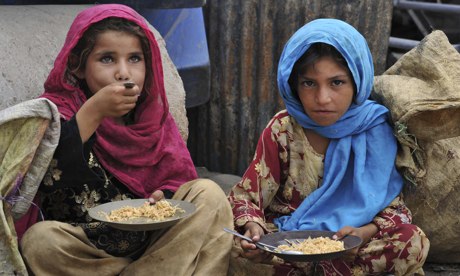
Afghan children eat a meal of rice in Jalalabad. More than half are believed to be stunted because of inadequate food. Photograph: AFP/Getty Images
Afghanistan is raising a stunted generation, whose hobbled development could spell disaster for the country's feeble economy and undermine the impact of billions of dollars in aid poured into health, education and other areas.
More than half of Afghan girls and boys suffer damage to their minds and bodies that cannot be undone because they are poorly fed in the crucial first two years of life, doctors and experts say. The revelation raises serious questions about the legacy of more than 10 years of western involvement in Afghanistan.
"After the age of two years, stunting is largely irreversible, and has an impact on growth and development and cognitive function," says Carrie Morrison from the World Food Programme. "Over the longer term, it can have a very damaging effect on the national economy. Young people are not able to attain what they should be able to attain. Women who marry young and are stunted themselves give birth to a small infant and the cycle goes on."
The problem of children who are not getting enough nutrients from their food is known as chronic malnutrition. It afflicts poorer countries worldwide, but in Afghanistan it is particularly widespread and persistent.
A decade after the fall of the Taliban, 55% of the country's children are stunted because of inadequate food, Afghan government and UN data shows.
The statistic is damning for western powers which have poured billions into Afghanistan to fund development and reconstruction. The US alone has spent $90bn (£54bn). Such funding aimed to transform Afghanistan from an impoverished, unstable country of largely subsistence farmers into a more modern nation, but return on that spending has been low.
With troops soon to head home, the returns have been limited. Violence is spreading and Afghanistan remains one of the world's poorest countries, with low life expectancy and poor healthcare for mothers and young children.
The malnutrition problem is caused by the basic poverty of those who can't afford healthy food, as well as poor hygiene and healthcare, child marriage, and a web of other issues.
"We have whole families where food insecurity means they are all malnourished, but we [also] even have rich families that have one child who is sick," says Alam Mohammad, a 25-year-old doctor who swapped the chance of an easy city practice to work in Feroz Nakhchair, on the gruelling frontline of a fight for the country's future.
Half an hour's drive down a dirt track from the nearest country road, in a valley on the fringes of Taliban territory, he sees dozens of cases a day like Mojabeen, whose leopard-print dress beneath her burqa seems incongruous with her life of constant hardship; at 19, she has three children and the family live in a one-room house on a flood plain that is periodically inundated.
Her husband earns $2 or $3 a day, if he can find work, which is not enough to feed the small family. "My second child is living with my mother, as we can't provide for him," says Mojabeen, as she waits for her baby to be weighed and examined.
Her children were at a disadvantage even before they were born because Mojabeen was so starved of nutrients that she could not pass on what they needed during pregnancy. In a district of around 13,000 people, the problem is so widespread that a programme set up for around 100 pregnant and breastfeeding mothers is already serving more than four times that number.
Nevertheless, it can be hard for charities and the government to focus attention or funds on chronic malnutrition when the country is battling a more dramatic type of hunger, which is also easier to address: acute malnutrition.
In clinics nationwide tens of thousands of babies and toddlers have experienced such severe shortages of calories that they have the protruding bones and distended stomachs familiar from photographs of famine victims. Acute malnutrition affects more than one in four children in some areas, but it can usually be resolved relatively quickly with a steady supply of high energy Plumpy'nut feeding paste.
In some ways, chronic malnutrition is harder to tackle as the children suffering from it often don't show their desperate need for help.
"You might see a child who appears underweight, or short for their age, but it doesn't really tell you much unless you line them up against a well-nourished child. But it prevents them growing up to lead a more productive life," says Morrison.
But appearances are disastrously deceptive. "It prevents them growing up for a productive life," she adds.
A lack of iron, which affects three-quarters of Afghan children, reduces activity and productivity. In young children, it disrupts brain development with effects including "stunting, sickliness, poor school attendance, and lower levels of concentration and memory". A lack of iodine "is the world's leading cause of preventable mental impairment", and a lack of vitamin A hobbles the immune system, pushing up death rates among children under five.
So severe is the damage that tackling it by lacing basic foods such as salt and flour with micronutrients has been rated one of the most economical ways to do good. "In the worst-affected countries, the benefits of supplementation with vitamin A and zinc can be up to 100 times higher than the costs," according to a research paper on the impact of giving children "micronutrients" – generally known in the west as "vitamins and minerals".
Recently, the government launched a five-year programme to fortify flour used to make ubiquitous nan flat bread – often the only daily food for poor families – oil and other foodstuffs. Gradual progress with women's education, healthcare and hygiene education is expected to bring slow but important progress.
A recent World Bank study found a direct link between sanitation and height: a five-year-old child in a community where everyone uses a toilet is on average more than 2cm taller than a child from one where people defecate in the open.
But poverty is also a pressing problem, in a country where a third of all citizens do not always know where their next meal will come from. A recent UN study found even a minimally healthy diet was beyond the reach of the majority of Afghans; in some provinces, only one in five could afford balanced meals.
And while the government and aid workers try to address problems that can take years to solve, healthworkers are often hobbled by a focus on more apparently pressing problems.
"We do worry about chronic malnutrition, but all we can give them is advice," says Nehmatullah Majidzafa, a nutrition nurse at an Oxfam-supported project in the shadow of the ruined ancient city of Balkh, where most funds support feeding the children in most obvious need.
That includes hands-on demonstrations, with nurses chopping onions into a basic pressure cooker before adding lentils, rice and vegetables, and warnings to spend spare money on protein rather than the cookies and cakes that many lavish on their children.
The information does help, because "parents don't know much about health here", says Mohammad, the doctor in Feroz Nakhchair, but still it troubles him to see those who arrive beyond the reach of his help. "If a child comes in after too long with chronic malnutrition, he cannot fully recover. We can only teach the parents so they take more care it doesn't happen with the other kids."
Hunger in Afghanistan
Extreme poverty and a harsh climate mean many Afghans go hungry. One-third of the population do not get enough food to live healthy, active lives, and another third hover around the borderline of "food insecurity", or not knowing where their next meal will come from. But the food shortages are particularly damaging to young children, who need to develop fast.
International studies show that children who are properly fed can earn between a third and a half more as adults than those who did not get a proper diet, the World Food Programme's Morrison says.
And overall malnutrition shaves 2%-3% off Afghanistan's national income each year, the World Bank says. That's around half a billion dollars lost to an already very poor country.
Subscribe to:
Posts (Atom)